July 27th, 2008 Milan
Because a warm muscle is more easily stretched than a cold muscle, stretching should be done after warm up.
Stretch with these principles:
- Spend 15-30 s in the stretched position
- Feel the stretch, not pain, feel a mild tension and hold for 15-30 s
- If the stretch becomes painful, you are stretching too far, ease up on the stretch
- Breath slowly, rhythmically
- Always breath when you stretch
- Natural , slow, relaxed breathing is right while stretching
- Hold the proper tension for long enough time (count silently 15-30 s)
Here is an example of a simple stretching session before your weight (resistance) workout:
After 5 – 15 min. warm up, hold each of these stretches 2 times for 20 sec.
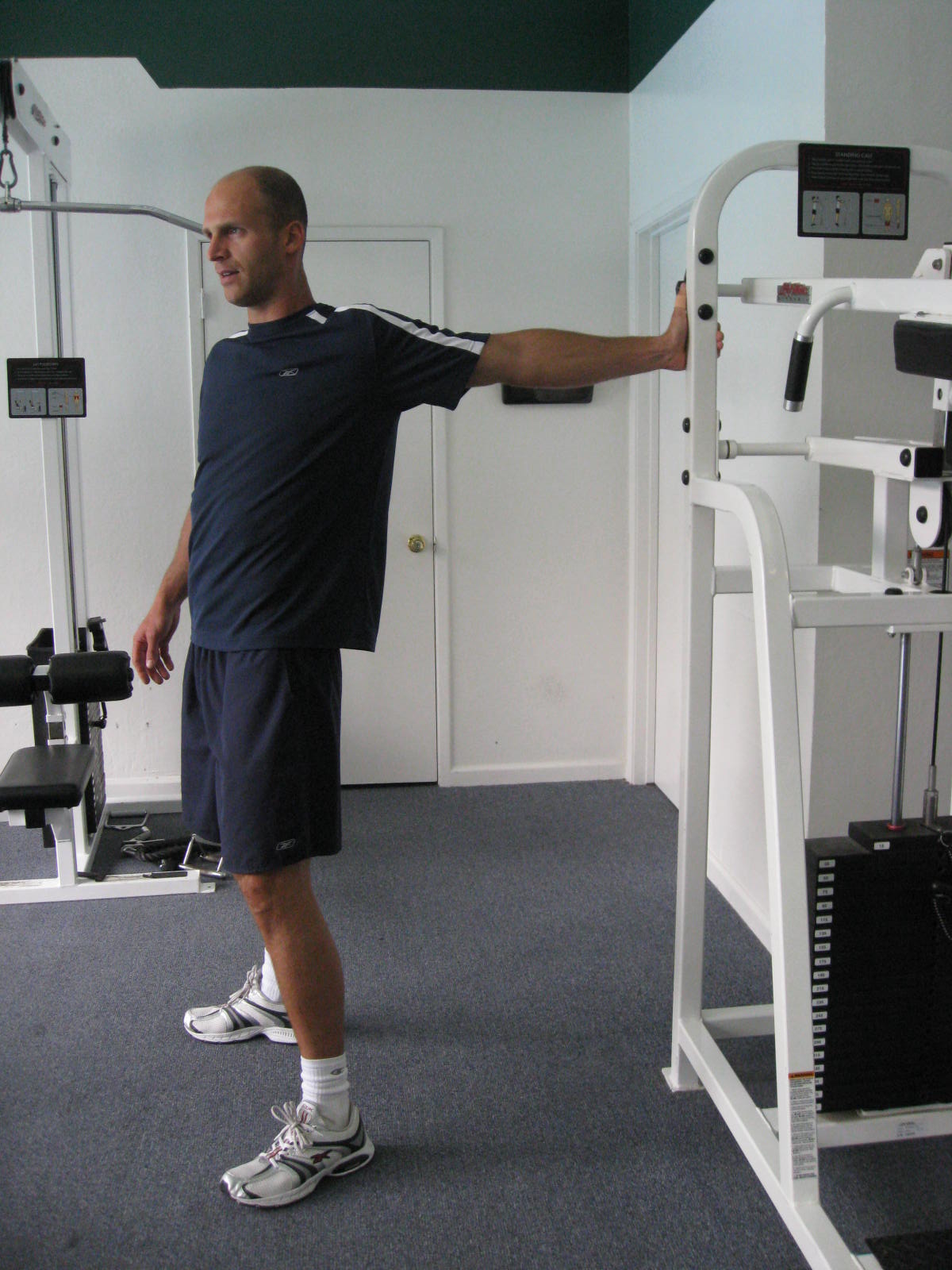
Chest and biceps stretch


Press against the support with your hand at little higher than shoulder level. Than step slowly little bit forward with leg closer to the stretched arm. Hold stretch for 20 sec. Repeat stretch on the opposite arm.
Back stretch

Place both hands shoulder width apart on a ledge (or the top of refrigerator or filing cabinet) or other kind of support. Let your upper body drop slowly down as you keep your elbows extended. Your hips should be directly above your feet. Hold stretch for 20 sec.
Triceps stretch


With arm overhead, hold the elbow of one arm with the hand of the other arm. Gently pull the elbow behind your head, creating a stretch. Hold stretch for 20 sec. Repeat stretch on the opposite arm.
Hamstring stretch #1


Slowly bend forward at the hips with your back straight until you feel a stretch in the back of extended leg. Hold stretch for 20 sec. Repeat stretch on the opposite leg.
Hamstring stretch #2

Keep your back straight when you lean forward. Try to grab your feet with your hands while keeping your knees extended. If you are not very flexible, use a towel around the bottom of your foot to do this stretch. Hold this stretch for 20 sec.
Quadriceps stretch

If you are tight, do not overstretch! Lean back, sit on your heels, put your hands on the floor and slowly lift your but up. If you can’t lift your but and put your hands on the floor because of tightness, stay only in the sitting on the heels position. Hold this stretch for 20 sec.
Caution: If you have or have had knee problems, be very careful bending the knees underneath you. Do it slowly and under control. If there is any pain, discontinue the stretch.
Cobra pose; abdominal, neck and hip flexor stretch

In the lying position lift your body up with your hands pushing against the floor. If you can’t go all the way up, keep your elbows bent and forearms on the floor. Try to look up and behind you. Hold this stretch for 20 sec.
And now after warm up and stretch, you can start your resistance (weight) workout.
More about stretching:
Posted in Stretching | 3 Comments »
July 27th, 2008 Milan
Every workout, regardless of your time constraints, needs to be preceded by a warm-up session. If you don’t have time to warm up, than you don’t have time to work out.
Warm-up prepares the body for what it is about to come – more intensive activity.
Warm-up is an activity that raises the total body temperature, as well as the temperature of the muscles, to prepare the body for vigorous exercise. It is part of the foundation of successful exercise session. Getting fully warmed up, mentally and physically, is a key aspect of attaining a training intensity required to achieve great results.
Warm-up protects against injury by improving flexibility of the muscles.
Here are some of the benefits you achieve with warm up:
- An increase in muscle blood flow
- An increase in the sensitivity of nerve receptors
- Faster moving oxygen from hemoglobin
- An increase in the speed of nerve impulse transmissions
Warm up guidelines:
In general the warm-up activity should last approximately 5 – 15 minutes, long enough for you to break out in a sweat.
It needs to be done with gradual increase of intensity – from 40% to 60% of maximal intensity.
You should choose activity mechanically similar to the primary conditioning activity and intensity should be well below that of the primary activity.
Examples of warm up activities:
- Stationary cycling – start with cycling against little or no resistance and gradually increase it
- Sprinting – jogging and graduated pace in running intervals
- Elliptical – Start with little resistance and gradually increase it
- Lap swimming – begin with slow crawl and gradually increase arm stroke, do some more intensive short intervals 1 – 2 laps
- Stationary exercise devices like rowing machine, stair masters, treadmills – begin with 40 – 60% of intended conditioning workload or speed and slowly increase
- Weight training – gradually warm up with all body activities like rowing machines or elliptical; treadmill is fine, but take some light dumbbells and move your hands too
Posted in Exercise planing | No Comments »
July 14th, 2008 Milan
If you ask people in the gym what they want to accomplish with their fitness regimen, most of them would say that they want to lose weight. But they’d be wrong. Most of them want to look better: they want to tone their muscles, fit into a smaller size, which doesn’t always correlate to a drop in pounds.
Most people who say that they want to loose weight really want to increase muscle and reduce fat.
Tracking body composition (fat %) in addition to weight is the best way to do this, since it gives you a more accurate view of your success.
If you are starting a fitness program you may actually gain weight as you develop muscle. This can be very discouraging.
Using body fat measurements can help you see that you are closer to your goal. That helps to keep you motivated!
In addition to body fat, measuring the waist and waist-to-hip ratio provides accurate measure of success.
The goal is to keep yourself from getting stuck in the mindset that the scale is the best way to track your success. It’s not!
Posted in Weight loss | No Comments »
July 9th, 2008 Milan
Older people who maintain their mental acuity tend to be both physically healthy and physically active. They are usually socially connected and they tend to be engaged in stimulating or intellectually challenging activities.
I heard that cardio exercise for six months will buy you 15 to 20 % improvement in memory, decision making ability and attention and I strongly believe that.
I believe that regular physical activity improves brain function, both by increasing blood flow to the brain and stimulating the production of hormones and nerve growth factors in building nerve connections.
Exercise also pays a role in countering diseases like Type 2 diabetes, which increases the risk of dementia.
Stimulation through interesting work, continuing education, reading, traveling, taking up new language or learning to play a musical instrument is also very beneficial.
Exercise or any intesive physical activity has also effect on decreasing stress, anxiety, depression and helps with improving memory and decision-making.
Try to maintain flexible attitude and be willing to try new things. And if you are older, you have to expect that things will shift over time and won’t be the same as when you were young. Those who manage to roll with punches, and enjoy change rather than fighting it, tend to do well.
Here are some examples of physical activities to learn, that have big stimulating effect on your brain:
- play table tennis – ping-pong
- play tennis
- jump rope – forward, backward, on left and right leg
- learn how to juggle with 3 balls – takes about 1 month to learn this
- if you are swimmer, try backstroke
- brush your teeth with left hand
- learn to roller blade, skate
- play games like volleyball, soccer, basketball, or any kind of new fun challenging game
You will get great cardiovascular exercise with most of these activities, plus you will stimulate your brain to build new nerve connections to make your brain perform better.
Posted in Health and fitness | No Comments »
July 4th, 2008 Milan
If you have a lot of problems, you are stressed and you need a break, you should focus on fitness. Intensive circuit training where you incorporate various exercises targeting all muscle groups will free you from stress. Cardio workout outside like running, biking, kayaking will make you happy again too.
Workouts that make you breathe harder help ease anxiety and tension long after you’ve finished your workout. This also applies to environment. Being outside in the nature, where trees or water is around, makes you relax faster.
Regular cardio and strength exercise, deactivates symptoms of stress by helping lower your resting heart rate and blood pressure. It downshifts your brain into low-anxiety gear.
Being active helps reduce stress, so when you feel anxious or stressed, get out for a quick run or walk and you will feel better. Guarantied!
Posted in Health and fitness | No Comments »