Teaching you how to achieve superior health, leanness and performance.
November 27th, 2009 Milan
Sleep is very important for your health and physical and mental performance. Active people have better, deeper, uninterrupted sleep. They usually need less sleep, because quality of their sleep is much better than the sleep of inactive people.
Inactivity causes bad sleep. Bad sleep causes obesity and decreased immunity system. Every vital function in your body slows down, causing you to get old fast.
Sedentary people have interrupted, not deep enough sleep, that makes them tired the next day. When they are tired, they don’t exercise. And the fallowing night, they don’t sleep well again, and so on.
Don’t let that happen to you. Be active. You don’t have to run 10 K right away. Start slowly and increase intensity and distance overtime. Go for a walk today. You will sleep better. Guaranteed. Than you will feel better next day. And you can go for faster, longer walk, and so on.
You really need a better sleep. It is seriously important for a good life. Get active. Strength train and do your cardiovascular exercise regularly and reap one of the great benefits of being physically active - great sleep.
Posted in The cost of inactivity | No Comments »
June 11th, 2009 Milan
To be active day in and day out means to have more energy for everything.
It’s mostly those fit people who tell you after exhausting hike, all day skiing or intensive tennis or soccer game : What are we doing tonight? Where are we going next? Do you want to go dancing tonight?
You think : Aren’t you suppose to be tired by now after all that you did today and just go sleep or watch TV?
Yes, those fit, active people are restless. Their bodies recover faster from hard physical activity and they want more. Their bodies work more efficiently.
And that’s why they stay active all the time. They don’t get fat. They don’t get sick. Their bodies work like a well oiled machine. They burn like a perfect roman candle.
If you are inactive, you are missing a big part of fun time in life. You don’t have enough energy to enjoy certain activities and you don’t have enough energy to do more things.
You need to exercise intensively at least 30 minutes 4 – 6 times per week doing strength, endurance and flexibility exercises for more energy.
Try some of my workout plans for more energy in your life.
Stay more active at work with these office (work) workouts:
Office workout – beginner # 1
Office workout – beginner # 2
Office workout – intermediate # 1
Office workout – intermediate # 2
Office workout – advanced # 1
Office workout – advanced # 2
Office workout guidelines
And don’t forget about stretching at work or office:
Stretch at work, office
Posted in The cost of inactivity | No Comments »
March 4th, 2009 Milan
Inactivity affects just about everything: brain, heart, blood vessels, bones, liver, gut, sleep, anxiety, mood, self esteem, and your body’s ability to process sugar.
Inactivity leads to excess abdominal fat.
One third of cancers of the colon, kidney, and digestive tract are caused by being inactive.
Being inactive causes diabetes and diabetes causes impotence, blindness, heart attacks, strokes, amputations and death.
Inactive people have poor sleep – they drag through their day sluggish and tired. Their bodies crave some quick energy, so they snack on some high-calorie junk food. That extra junk food leads to more fat, which leads to……you get the picture.
You have to be active if you want to stay healthy and alive. Being active equals great life.
Get more active with these workout plans:
Workout plans and more
Posted in The cost of inactivity | No Comments »
January 30th, 2009 Milan
Bone is like any other part of your body, if you stress it, it responds, it becomes stronger. If you don’t stress it, the ongoing balance between bone buildup and breakdown shifts toward net loss of thickness and with that flexibility. The result is – weak bone you can easily break.
Strength training can make a big difference in keeping bones strong and healthy. Whether you actually gain bone or hold on to it depend on how much you stress, or overload the bone.
If you can get anything from this article, this is it: Strength training preserves bone better than walking or running.
Load is more important than repetitions, so a small number of repetitions with a heavy load stimulates bone formation more than walking or jogging, where you can do thousands of repetition but the load is light.
How much is enough? You shouldn’t be able to do more than 15 repetitions in 2 or 3 set of exercise. On the other hand, if you can’t do 8 repetitions, it’s too much of a load.
To build a stronger bones, try one of my two simple and effective strength training plans:
Workout plan #1 – simple, effective and safe all-body-machine-resistance workout
Workout plan #2 – more extensive intermediate all-body-workout with combination of machines and free weights
Posted in The cost of inactivity | No Comments »
February 13th, 2008 Milan
People, who are active are less likely to develop depression.
In study of nearly 2,000 residents of Alameda County, California, people who were more active were nearly 20 percent less likely to be diagnosed with depression over the next 5 years than less active residents.
Being physically active helps if you are already depressed.
More intensively you exercise, better you feel, less depressed you are.
I know people, who work out intensively every day to overcome fear, anxiety and the result usually is: they feel very confident, they have very strong minds, they are mostly in very good mood, and they are very decisive.
I also see it on myself. After I had a flu recently, I could not work out for couple of weeks, and I felt not only week physically, but also mentally. I could really feel the difference in my mind.
What is interesting, I felt kind of week mentally, only after two weeks of not exercising. I can’t even imagine the negative feelings of a really inactive person.
For the best effect, try to exercise every day at least 30 minutes, combine resistance workout with cardiovascular workout, and if you are a regular exerciser, don’t be afraid to speed up a little or do a few more of those hard repetitions at the end of the set, and you will really feel great.
Posted in The cost of inactivity | No Comments »
December 19th, 2007 Milan

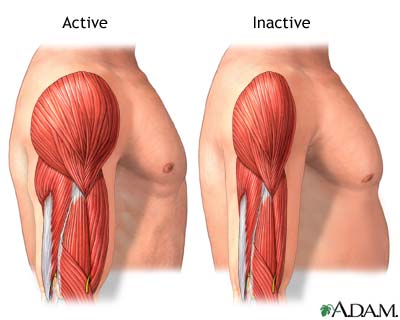
It happens earlier in women than in men, but in both genders muscle starts to wither away if it’s not used.
University of Maryland’s Ben Hurley and Coopers Institute’s Steven Blair point about muscle mass loss and inactivity:
- Muscle atrophy for people with average activity levels starts at age 40 for women and in the late 50s for men
- For every decade after about age 50, you lose some 6 percent of your muscle mass, which comes with a 10 to 15 percent loss of your strength
- Anyone can build muscle back up with strength training exercises. After two months of training, we see a 40 percent increase in strength
- The earlier you start, the better. But even people over 100 years old can partially reverse some of the loss that occurs with aging
- The trick is to not just use the muscle, but to overload it. You have to make it work harder than it’s accustomed to
- If you overload it in a gradual, progressive way, you can make the muscles bigger and stronger by making each muscle fiber thicker
Posted in The cost of inactivity | No Comments »
November 21st, 2007 Milan
Every year, 1.2 million Americans have a heart attack.
Exercise affects the function of hearth muscle, but it also affects the blood vessels, from the large aortic artery to the large capillaries.
Exercise:
- can boost your HDL (“good”) cholesterol
- makes the lining of blood vessels more flexible
- has beneficial effects on risk factors for heart disease like lipids, blood pressure and insulin sensitivity
If partially blocked arteries are more elastic, they can relax better and send more blood to the heart muscles.
You don’t have to be an athlete to protect your heart.
In a study that tracked nearly 40 000 women for five years, those who walked briskly for at least an hour a week were half as likely to be diagnosed with hearth disease as those who did no regular walking. The risk was even lower for women who jogged or did other vigorous activity.
What’s more, researchers have tested the impact of exercise training on people who already have heart disease.
“If they are assigned to an exercise program, they have a lower risk of dying and dying from heart disease,” says I-Min Lee, associate professor of epidemiology at Harvard School of Public Health in Boston.
Posted in The cost of inactivity | No Comments »