July 27th, 2008 Milan
Every workout, regardless of your time constraints, needs to be preceded by a warm-up session. If you don’t have time to warm up, than you don’t have time to work out.
Warm-up prepares the body for what it is about to come - more intensive activity.
Warm-up is an activity that raises the total body temperature, as well as the temperature of the muscles, to prepare the body for vigorous exercise. It is part of the foundation of successful exercise session. Getting fully warmed up, mentally and physically, is a key aspect of attaining a training intensity required to achieve great results.
Warm-up protects against injury by improving flexibility of the muscles.
Here are some of the benefits you achieve with warm up:
- An increase in muscle blood flow
- An increase in the sensitivity of nerve receptors
- Faster moving oxygen from hemoglobin
- An increase in the speed of nerve impulse transmissions
Warm up guidelines:
In general the warm-up activity should last approximately 5 - 15 minutes, long enough for you to break out in a sweat.
It needs to be done with gradual increase of intensity - from 40% to 60% of maximal intensity.
You should choose activity mechanically similar to the primary conditioning activity and intensity should be well below that of the primary activity.
Examples of warm up activities:
- Stationary cycling - start with cycling against little or no resistance and gradually increase it
- Sprinting - jogging and graduated pace in running intervals
- Elliptical - Start with little resistance and gradually increase it
- Lap swimming - begin with slow crawl and gradually increase arm stroke, do some more intensive short intervals 1 - 2 laps
- Stationary exercise devices like rowing machine, stair masters, treadmills - begin with 40 - 60% of intended conditioning workload or speed and slowly increase
- Weight training - gradually warm up with all body activities like rowing machines or elliptical; treadmill is fine, but take some light dumbbells and move your hands too
Posted in Exercise planing | No Comments »
March 15th, 2008 Milan
Abdominals are the focal point of a well-developed physique. A lean, muscular waistline is indicative of the active lifestyle.
Here are the main keys to exceptional abdominal development:
- Keep repetitions between 10 and 30
- Eliminate exercises that tend to emphasize the development of the hip flexors
- Work out from large to small (lower abdomen, than right, left outer abdomen and than upper abdomen)
- Maintain constant tension on the muscles
- Emphasize quality of movement not quantity of movement
- Attack the abdominals from variety of angles using a variety of movements
- Train your abdominals 3 to 4 times a week
- Reduce caloric intake and increase energy expenditure to reduce body fat levels.
Other important facts about abdominal muscles:
Abdominal exercises do not “spot reduce” fat from the waist.
By eating wisely and exercising properly, it is possible to increase your lean muscle mass while decreasing your body fat %.
The abdomen is comprised of four muscles:

The abdominals can be divided into four major chambers:
The rectus abdominis is the largest of the muscle groups that comprise the abdomen, so train the rectus abdomens first, more specifically, the lower chamber of the rectus abdominis.
As you train these lower chamber, both side chambers and the upper chamber are also receiving some work.
If you were to train the upper chamber first, your lower abdomen would not become completely exhausted because the smaller upper chamber would fatigue before the larger chamber.
You should train your abdominals:
- lower chamber first
- the right/left outer chambers second
- upper chamber third
Naturally, the upper chamber won’t require much extra work because these chamber receives a great deal of work during the other abdominal movements.
Posted in Exercise planing | No Comments »
March 10th, 2008 Milan
It depends on your level of fitness and how many exercises and sets you are going to perform.
For all body weight training per session: 50 - 60 minutes is a right time.
Don’t forget, that you have to:
- Warm up for at least 7 min before workout
- Stretch for 5 min after warm up
- Cool down for at least 2 minutes at the end of the workout
If you are pressed for time, you can do a primary weight training session at the gym, and finish at home (push ups, abdominal exercises).
The key is to perform quality session and to perform the exercises with serious effort.
Posted in Exercise planing | No Comments »
March 8th, 2008 Milan
2 to 4 days of rest, depending on the intensity of the workout is the right time for recovery, writes Ben and Joe Weider in their book The Edge - The Weider Guide to Ultimate Strength, Speed and Stamina:
The exact time it takes your muscles to fully recover from a weight training session will depend on your genetics, sex, age, and level of fitness. In general men recover more quickly than women, and young people recover more quickly than people 35 an over.
You usually need 3 to 4 days for muscle group to recover after high intensity weight training, and 2 to 3 days to recover after moderate and light weight training sessions.
I think, that 4 days is too long of a recovery time for exercised muscle group even if it’s worked out very intensively.
There should be at least 1 day, but not more than 3 days between workouts that stress the same muscle group or groups.
Examples of scheduled weight training sessions:
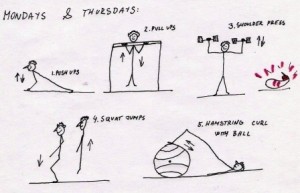
All body weight training per session # 1: Mondays and Thursdays
All body weight training per session # 2:
Tuesdays - high intensity
Thursday - low intensity
Sunday - high intensity
Split routine:
Monday - upper body
Tuesday - lower body
Thursday - upper body
Friday - lower body
Posted in Exercise planing | 1 Comment »
December 22nd, 2007 Milan
Here is my super efficient workout system:
Day 1- Resistance workout
Day 2- Cardio- long slow distance
Day 3- Cardio- Interval training
Day 4- Resistance workout
Day 5- Cardio- long slow distance
Day 6- Cardio- Interval training
Start all over again with day 1.
Day 1
All body resistance workout - consisted of 90 percent of core exercises and 10 percent of assistance exercises.
45 min. - 1 hour workout in gym or home with combination of free weights, machine, heavy balls and bands exercises.
Core exercises - They are more effective at helping people reach their exercise goals. A core exercise must meet these two criteria:
- It should involve movement at two or more primary joints, they are also called multi joint exercises
- It should recruit one or more large muscle groups or areas (chest, shoulders, upper back, hips/thighs) with the synergistic help of one or more smaller muscle groups or areas (biceps, triceps, abdominals, calves, neck, forearms, lower back, shins). One core exercise can affect as many muscles or muscle groups as four to eight assistance exercises.
Assistance exercises - Often, people perform assistance exercises to maintain muscular balance across joints, help prevent injury or rehabilitate previous injury, or isolate specific muscle or muscle group. An assistance exercise must meet these two criteria:
- It must involve movement at only one primary joint, they are also called a single joint exercises
- It must recruit a smaller muscle group or only one large muscle group area
Day 2
Aerobic (cardio) workout - Long slow distance cardio training 35 - 45 minutes at Heart Rate (HR) - 60 - 80 percent of your maximum HR.You can count your maximum heart rate from these formula:
Age-predicted maximal heart rate (APMHR) =220-age
You can perform your aerobic workout by running outside or on the treadmill, or using any cardio machines as: elliptical, rowing machine, bicycle, step master and other. I personally prefer doing my cardio workout outside - running, biking, swimming.
Day 3
Aerobic (cardio) interval workout- 8 minutes warm up (intensive warm up), 10×1minute maximum intensity (sprint)/1 minute light intensity, 2 minutes light intensity - cool down
Day 4
All body resistance workout- same principles apply as day 1 workout, with different exercises.
Day 5
Aerobic (cardio) workout - Long slow distance cardio training 35 - 45 minutes at Heart Rate (HR) - 60 - 80 percent of your maximum HR.
Day 6
Aerobic (cardio) interval workout- 8 minutes warm up (intensive warm up), 5×2minute 95 percent of maximum intensity/2 minute light intensity, 2 minutes light intensity-cool down.
Start again with day 1 after day 6. If you need a day off, try to have only one and pick aether day 2 or day 5 as your day off.
Posted in Exercise planing | No Comments »