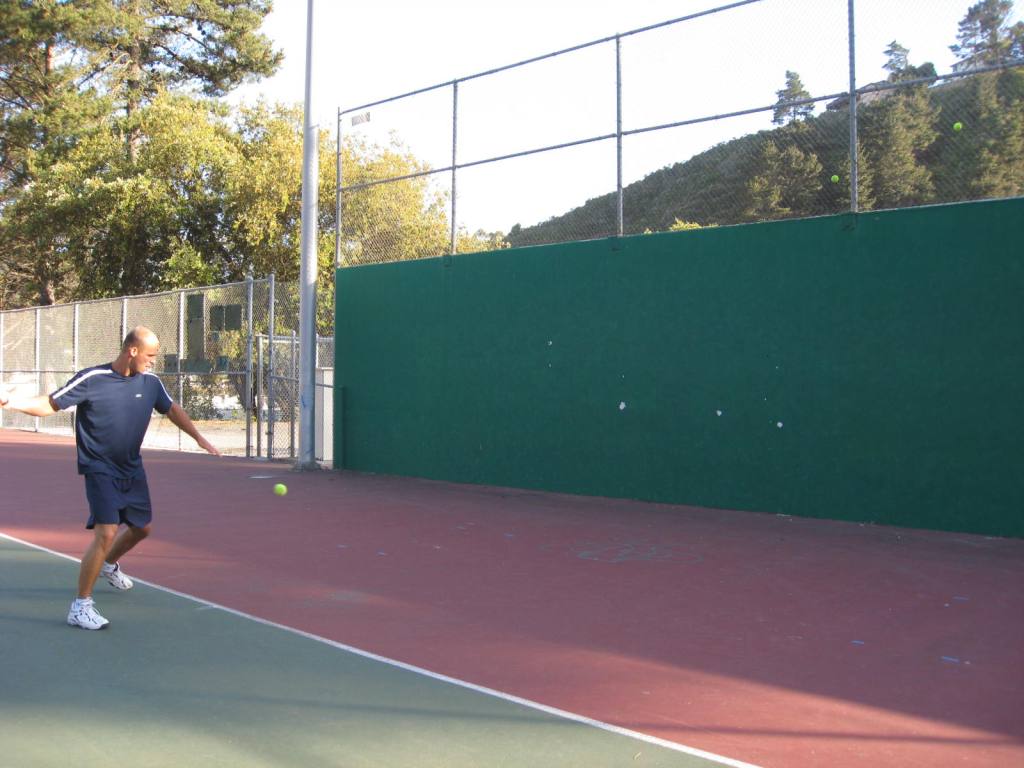
Just about any skill that a player needs for a match can be learned and developed against wall (backboard). With another conditioning exercises in these workout plan you will develop great endurance and strength while improving your tennis strokes.
If you are a beginner, use an old ball with a slower bounce to take a better control.
What will you need? You need only tennis racket, ball, wall and tennis court – not necessary.
Warm up: Only in first circle – use 60 % of your maximum intensity hitting against wall. Than use maximum intensity in second and other circles.
1. Forehand drill against wall – 3 minutes
Assume the ready position.
Contact point of a tennis racket and ball is in front of the body.
Fallow through with good shoulder rotation and balance.
2. Backhand drill against back board (use aether one handed backhand or two handed backhand) – 3 minutes
Assume a ready position. Step out with foot closes to the ball.
Contact point of a racket and a ball is in the front of the body. Fallow through with good shoulder rotation, extension and balance.
3. Forehand volley drill against wall – 3 minutes
Come closer to the wall. Practice volley against wall without letting the ball fall.
4. Backhand volley drill against wall – 3 minutes
Come closer to the wall. Practice volley against wall without letting the ball fall.
5. Sprint on court; if tennis court is not available, you can set up sprinting lines by yourself anywhere close to the wall you are practicing your strokes.
This is not a warm up anymore. It is a sprint/interval workout.
Start in the front of a end (doubles) sideline. Sprint toward the middle line.
You can determine intensity of your exercise from Perceived Exertion Scale, which is designed to estimate the intensity of exercise based on how you feel as you are working out. It correlates well with the target heart-rate zone formula.
On the Perceived Exertion Scale:
low-intensity level corresponds to 5 or 6, so if you walk as your workout, it should feel somewhat difficult
mid-intensity level corresponds to 6 or 7, walking should feel difficult, but not extremely so
high-intensity walking, running or any other cardiovascular exercise corresponds to levels 7 to 9, so high intensity cardiovascular exercise should feel somewhere between difficult and extremely difficult
Higher intensity in your workout can help you loose weight faster and achieve better fitness level:
Canadian researchers reported that just two weeks of interval training boosted women’s ability to burn fat during exercise by 36 percent
Levels of human growth hormone – which assists in building muscle and eliminating fat – skyrocketed 530 percent in subjects after just 30 seconds of sprinting as fast as they could on a stationary bike, according to British study
Australian fitness researchers had 18 women perform 20 minutes of interval training on stationary bike – eight-seconds sprints followed by 12 seconds of recovery throughout the workout, three days a week. The women lost an average of five and a half pounds over 15 weeks without dieting, while a similar group performing 40 minutes of moderate cycling three days a week actually gained a pound of fat over the same period. Two of the heavier women who did intervals dropped 18 pounds.
Here is my simple cardio work out for you: you can run, bike, swim, elliptical train, even speed walk. What’s important is that during the interval, you push yourself hard enough that you can’t maintain the effort longer than 60 seconds.
Warm up 8 minutes
Start your first 60-second interval, if you are walking and don’t want to run, increase the incline on the treadmill 3 to 6 percent and speed up enough to feel that you’re working hard
The effort should feel like 80-90 percent of your maximum for the first 3 sprints, than 100% (maximum intensity) the rest of the sprints
After 60 seconds, recover at a casual relaxed pace, about 30 percent of your maximum (slowly) for 60 seconds, and then do it again for total of 10 intervals
Finish with a 2 minute cool down
The workout will take 30 minutes
Other important tips
Your body needs time to adapt to the intensity of intervals. If you’ve been very sedentary, ease into the intensity by brisk-walking the intervals to start. For those unused to a fast pace, do just three moderate sprints for fist week and add one sprint every week until you do ten sprints
Allow a day of active rest between interval workouts to give your body time off to recover. What could you do as a active rest? Walk outside easy for 30 minutes or swim in relaxed pace, bike slowly – active rest rule – your hearth rate should not go higher than 60 percent of your maximum heart rate. Your maximum heart rate = 220 – your age. Our body actually recovers actively faster.
As with any exercise program, talk to your doctor before starting
Keeping intervals interesting
It is very easy to vary intervals to keep workout even after a while interesting:
Three-two-one interval training
Warm up – 5 minutes easy to moderate pace – (30-60 percent) of your maximum effort
Increase intensity (70 percent) – 3 minutes
Push a little harder (80 percent) – 2 minute
Keep increasing your effort for 1 minute, and finish last 10 to 15 seconds as hard as you can go (100 percent)
Recover – 5 minutes (30-50 percent)
Repeat three-two-one interval
Recover – 5 minutes
Cool down – 3 minutes
Total work out time – 30 minutes.
Two by two interval training
Warm up – 5 minutes – easy to moderate effort (50-60 percent)