Functional and Mental Performance, Prevention, Health and Great Look through Fitness an Wellness
June 24th, 2008 Milan
Healthy muscles are those that have been worked, stressed and pushed to their limit so that they have enough power and strength to get you through life, especially as you grow older.
Why does muscle matter? Muscle is the absolute centerpiece for being healthy, vital, and independent as we grow older. It keeps us strong and mobile. It tugs on bone to help bone stay strong. It burns more calories. Muscle and lean body mass are the metabolic engine in you body. More muscle means that your metabolic rate goes up, which makes it easier to stay lean.
Your muscles don’t have to be big, they just need to be fit. Some people have genetic inability to build muscles. Women can’t build muscles, due to low levels of hormones that men have. Healthy muscles are those that are worked, stressed and pushed to their limits so that they are strong and fit.
Here are some facts about muscles, strength training and their importance for overall health:
- Starting in their late 30s or early 40s, most people lose about a quarter pound of muscle every year. Beside aging process, much of these is caused by physical inactivity.
- Building muscle means lower blood sugar, which means less chance to develop type 2 diabetes. When muscles aren’t used, their cells become resistant to the insulin. If your muscle cells are resistant to insulin, you have a higher risk of heart disease.
- Doctors say, that even if you already have diabetes, strength training which brings muscle gain and body fat loss will improve your blood sugar control and will lover your blood pressure.
- Strength training lowers the risk of osteoporosis. Each year after menopause, a woman typically loses one percent of her bone mass. Over time, the bone loss can lead to osteoporosis, when bones are so porous that they can easily break.
- More muscle/strong muscle also mean better prevention against bone fractures because of better bone density. The odds are high that 70-year old woman will break her hip if she lives to 90. Depending on the age of the person, many will need care and many will die within year.
- More muscle/strong muscle means independence, less falls. The frail elderly aren’t strong enough to do instrumental activities of daily living like grocery shopping, walking up and down the stairs. That’s why strength training is so important for them.
- Strength training helps people regain their confidence which also helps fight depression. they become more active because they’re stronger and feel more energetic. Depression is common in older people, and disproportionately affects older people and especially older women.
- With strength training, people sleep better, they sleep deeper, they sleep longer, and they have fewer awakenings.
- Muscle strength reduces arthritis pain. It works with both rheumatoid arthritis and osteoarthritis. Many people with moderate to severe arthritis have weak muscles. It’s very important to keep muscles around the joint strong and in balance. When the muscles are stronger and in balance, they absorb more shock coming from walking, and other daily life activities.
- Strength training reduces risk of heart disease.
- People who do strength training look better. Weight control becomes easier because their metabolism is better. With strength training people get firmness that they love.
- Strength training curbs back pain. Many people sit at their desks all day, than they have weak abdominal and lower back muscles, short hamstrings, which are risk factors for lower-back pain. Strengthening those muscles will reduce the pain.
- Having fit muscles turns back the clock. At any age, if you’re exercising you’re going to be like a younger person who has not been exercising that much.
If you don’t work your muscles, they will atrophy. Older people often fall, because they are too weak, their muscles are week and therefore their balance is bad, and they have trouble with climbing stairs and opening jars because their muscles have lost so much strength.
There are 3 aspects to healthy muscles:
- Endurance
- Strength
- Flexibility
The most effective way to stimulate muscles is with a system known as progressive resistance. You’re strength training all body 2 or 3 times per week.
- Once a week you lift weights so heavy that you can do only 5 - 7 repetitions before your muscles are too tired to lift again.
- Other day is devoted to moderate resistance, with weights you can lift 8 - 13 times.
- Than you should have some light days, with weight you can lift 15 - 20 times before your muscles tire.
You should stretch your muscle parts in breaks between sets when you weight train.
Women often don’t want to lift heavy enough weights because they’re afraid they will bulk up. But they won’t. Acquiring muscle mass requires testosterone levels that women don’t have. Especially women should not be afraid to lift heavy enough weight to fully stimulate their muscles.
Here are some tips, how to start weight training program:
- You should strength train all major muscle parts of your body 2 to 3 nonconsecutive days per week . If you’re consistent with it, you will see results soon.
- You should do 2 to 5 sets of each major muscle part with 7 to 15 repetition.
- It should be done in moderate to high intensity. No 1 or 2 pound dumbbells. In the case of gaining strength, the weight should be such that you can lift it 9 - 13 times in good form, but after that it feels heavy and you can’t lift it correctly.Than you need to rest before you do another set.
- Lift weights at this pace: 2 sec. lift - 4 sec. slowly lover the load.
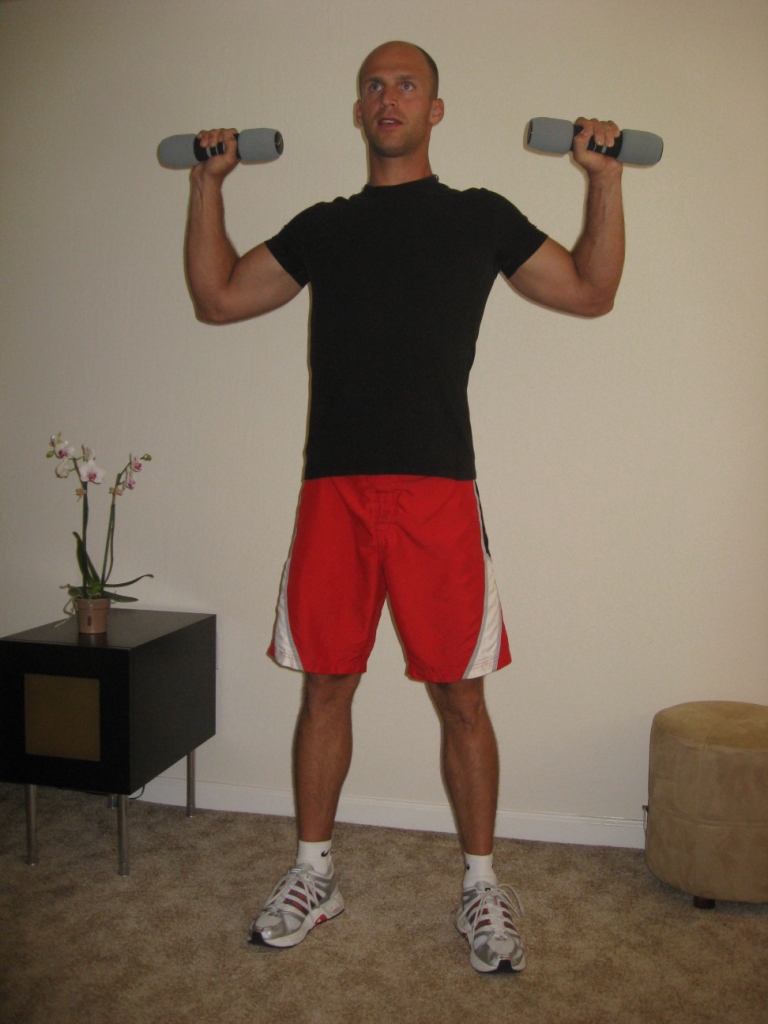
- You can weight train at home.
- You need to do 7 to 10 exercises to do all body workout.
Posted in Weight training | No Comments »
June 13th, 2008 Milan
What if your strength training comes in less traditional form than dumbbells or machines? Devotees of disciplines like yoga and Pilates say they get all the lean muscle they need from their chosen disciplines.
But I disagree. You will build some muscle with yoga asanas (poses) that have you supporting your body weight against gravity, but eventually you”ll reach plateau and will need to add weights or some other form of resistance. Pilates mat classes present the same limitations. You won’t get the same weight-bearing benefits of any poses than when lifting weights.
Body sculpting classes can be a great thing to do. If you do take sculpting classes, make sure you’re working at the right intensity, or you’ll stop seeing results. You need to be fully fatiguing muscles, it doesn’t matter what is providing resistance. Best way to do that is to use free weights and machines, but you can also use resistance bands, medicine balls or heavy bars.
Posted in Weight training | No Comments »
June 6th, 2008 Milan
Despite the universally acknowledged health benefits of resistance training, of the 12.7 million women who belong to health clubs, only about half use weight machines and only one-third lift free weights.
Weight training - just two times a week is an essential part of the total wellness package.
For optimal health and fitness benefits, especially women need to do a combination of aerobic and strength training on regular basis.
Weight training has a lot of benefits for womans body in any age.
What intensive, regular weight training does to woman body?
- reduces blood pressure
- strengthens bones, muscles and connective tissue
- changes body - body looks younger
- boosts mood
- fights aging process by maintaining lean muscle tissue
- burns fat
- improves muscle tone
- increases bone density
- increases athletic performance and strength
- women who regularly lift weighs have better self-esteem
- they get sick less often
- improves the way the body processes sugar, reducing the risk of diabetes
- it is key factor for loosing weight or preventing weight gain
- builds lean muscles - 2-4 pounds of muscle = extra 100 calories burned each day
- increases metabolism for several hours after workout
- decreases resting heart rate
- decreases body-fat %
- by keeping body strong, it prevents injury
- by strengthening body, it makes daily demands of life, like picking up a child, carrying groceries easier
Even with all these benefits, many women still resist strength training for one reason: fear of getting bulky.
The reality, however, is that it’s physically impossible to build bulky muscles like a guy. Women don’t have the hormonal makeup to get as muscular as men. In fact studies show that combining resistance training with regular cardio workout will only help you look leaner as you become stronger.
Women should do two full-body strength workouts a week. They should be done on two nonconsecutive days and you can do them in as little as 25 minutes.
Posted in Weight training | No Comments »
May 20th, 2008 Milan
Core exercises - They are more effective at helping people reach their exercise goals. A core exercise must meet these two criteria:
- It should involve movement at two or more primary joints, they are also called multi joint exercises
- It should recruit one or more large muscle groups or areas (chest, shoulders, upper back, hips/thighs) with the synergistic help of one or more smaller muscle groups or areas (biceps, triceps, abdominals, calves, neck, forearms, lower back, shins). One core exercise can affect as many muscles or muscle groups as four to eight assistance exercises.
Posted in Weight training | No Comments »
December 10th, 2007 Milan
No! Women I train gain about 9 percent of muscle mass, enough to make an enormous difference in their strength. But they loose a corresponding amount of fat - and since muscle is denser than fat, they become trimmer. They don’t complain about looking unfeminine. On the contrary, they are delighted with their slimmer figures.
Women bodybuilders go to great lengths to produce those bulky muscles. They use extremely heavy weights, have lengthy intense workouts, and often take steroids and follow rigorous diets.
Posted in Weight training | No Comments »
December 7th, 2007 Milan
Beside building muscles and increasing strength, strength training has more benefits:
- Halts bone loss - and restores bone
Each year after menopause, a woman typically loses 1 percent of her bone mass - even more during the first five post menopausal years. Over time, she may develop osteoporosis, a condition in which bones become so porous they easily break. Strength training significantly enhances the bone density.
Our ability to stay in balance declines with passing years. Those who regularly weight train perform significantly better at balancing tests than sedentary people and those active but without regular strength training.
- Helps prevent bone fractures from osteoporosis
The improvements in strength , bone density , and balance have special significance for women because they dramatically reduce the risk of fractures from osteoporosis.
The stronger you are, the easier is to move.
People who weight train gain muscle mass and in the same time while loosing body fat they loose also inches.
Gaining muscle not only promotes aerobic activity, which burns calories, but also boosts metabolism. That’s because muscle is active tissue and consumes calories; stored fat, on the other hand, is inert and uses very little energy.
When strength training exercises are performed with maximum range of motion, they improve flexibility of the muscles.
Strength training makes you feel great. It gives you a positive feeling about anything you want to do.
Posted in Weight training | No Comments »
October 15th, 2007 Milan
Along with the other benefits of getting in shape - increased self-confidence, improved mood, longevity, and health - weight training has benefits of its own. While looking good in a bathing suit is great, there are even more reasons to get toned.
Lifting weights builds muscles that can help you loose weight. Muscles burn more calories than fat because muscle is more metabolically active than fat, even when you’re standing around and even while you sleep. In short, muscles are calorie-hungry in general and at all times burn more calories than does fat.
The benefits of building strong bones
Weight-bearing exercise increases bone density. This is especially important as we get older because bone density, which increases until we’re about 30 years old, begins to decrease after that age.
Weight-bearing exercise helps prevent osteoporosis, a progressive decrease in bone density that weakens bones and makes them more likely to fracture.
It’s much easier to prevent osteoporosis than to treat it. This disease affects millions of people, especially older women. Even if you are a healthy male, keep reading. Twenty percent of the victims of osteoporosis are men. And if you’re an older adult, strength training can help you remain independent. As you get stronger, you increase your ability to move around and reduce your chances of failig. Also, building bone density helps prevent hip and spinal fractures and other problems that can develop with age.
Lift weights to improve posture
Strong back muscles lead to better posture and fewer lover back problems. Muscle building increases power and strength, making you more confident in all aspects of your life.
Many athletes include weight training in their fitness routine to improve their performance and to build strength that prevents their chances of injury.
I’ve been weight training regularly since beginning of my high school studies and can tell, that consistency and intensity are the keys to lean, healthy, solid body. I’m north California surfer, where waves get sometimes bigger that I can handle. While keeping strong body by lifting weights, I’ve been able to manage my falls on steep waves without injury.
Posted in Weight training | No Comments »