April 23rd, 2008 Milan

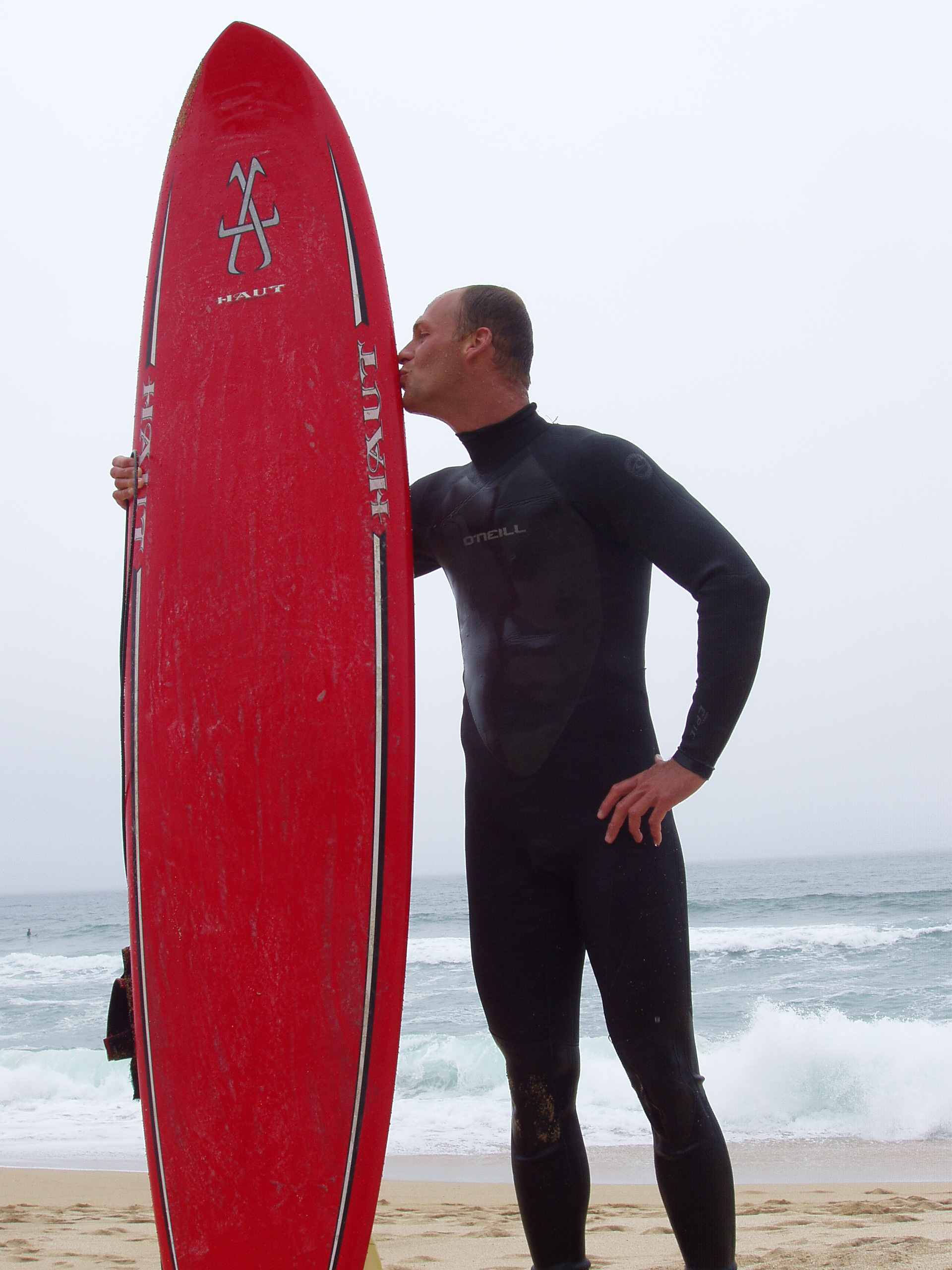
Surfing is great exercise.
It gives you the whole package:
- paddling is good for your cardio
- pulling yourself up is a good arm workout
- balancing gives you a core and leg workout
- you feel like a different person after 2 hours of surfing
I will be in Maui for 8 days, leaving tomorrow.
Plan of my trip is mainly – surfing.
Posted in Health and fitness | No Comments »
April 22nd, 2008 Milan
If you suffer from stiff or achy joints, don’t do exercises that add stress to those joints. You may experience mild discomfort during exercising, but if the joint pain becomes moderate or severe, you should stop performing the exercise and see a physician before resuming it.
People with rheumatoid arthritis should not exercise during an inflammatory episode in which the joints are painful, swollen, red, or hot.
The following adaptations will help person with arthritis benefit from an exercise program without damage to the joints:
- warm up for longer period of time: 15-20 min. to promote flexibility and range of motion
- use exercises of mild to moderate intensity
- exercises should be performed slowly and with good control
- for aerobic exercises, the intensity depends on joint limitations, fatigue and ability to achieve training heart rate
- include aerobic exercises that keep weight off the affected joints, such as cycling, rowing, swimming, or water exercise
- use proper body mechanics – mainly maintain good posture
- include strength exercises to increase muscle tone and functional strength – increased strength surrounding the joints = joint protection
- strength training should focus on joint mobility and range of motion
- use light weight at a resistance of 40-60% of 1 rep-maximum for 15-20 repetitions in each set
- increase the use of isometric exercise, which increase muscular strength and endurance with no joint movement
- if you experience extreme fatigue at the beginning of a session you should not exercise that day; fatigue is a side effect of arthritis
- expect to feel discomfort and painful joint; if discomfort is greater than normal, discontinue the exercise or eliminate that particular movement from the workout
- follow the 2-hour pain rule, which means that you have overexercised if you experience excess joint pain or greater than normal pain 2 hours after your workout
- respect your own limits and find proper balance between rest and exercise
- water exercise – water supports the body, decreasing weight on the hips, knees, ankles, feet, and spine
- the water temperature for aquatic workouts should be 83 – 88 Fahrenheit; warm water helps relax muscles and decrease joint stiffness
Posted in Arthritis and exercise | No Comments »
April 17th, 2008 Milan
These steps will help you stay motivated for your important regular workout:
- select pleasant locations for your workouts; try to avoid stuffy gyms, smell of automobiles, unappreciative audience
- do your workout outside as much as you can; I personally think that majority of your cardio workouts like running, swimming, biking, playing tennis, soccer, rowing, kayaking should be done outside
- wear appropriate clothing, maybe even a bit “professional” looking
- be careful about exercise in hot and humid weather; your exercise will feel more pleasant if done early or late in the day when the sun is low
- for running, cycling, cross country skiing, try the hills, a rolling terrain where uphill is mixed with downhill and level progression is ideal
- persevere! On occasion you feel like getting lazy, fool yourself, stop thinking, go to the closet, put on your exercise clothes very fast, get out of your house and start running or walking immediately, try to run or walk for 30 minutes
Posted in Health and fitness | No Comments »
April 16th, 2008 Milan
Bicycling is an excellent activity for aerobic conditioning, but:
- it is extremely efficient method of covering distance
- you use less than 1/4 the calories of brisk walking and 1/6 the calories of running a set level of distance if you cycle it
- the energy cost of cycling 15 miles is the approximate equivalent of covering 3 miles on foot
- to burn calories for weight control, a very long distance must be covered
If you really want to get in shape by bicycling, take your heart rate monitor with you and keep your heart rate between 130 – 160 for extended period of time, for at least 30 min. The best thing you can do to get great cardiovascular workout on bicycle is to ride it uphill. You should combine bicycling with other cardiovascular exercises like running, swimming, rowing and other.
Posted in Health and fitness | No Comments »
April 11th, 2008 Milan
Flexibility is an often overlooked or under emphasized component of general fitness.
Adequate muscular flexibility is important in maintaining range of motion as well as preventing injuries.
Flexibility programs should address all major muscle groups.
If you have a certain limitation in flexibility, or you are trying to develop flexibility of certain muscle group more, than you need to focus more on these muscles.
I have a very fit and active friend who is trying to achieve better than average flexibility of his hamstrings. Here is, what he needs to do:
- warm up for at least 7 minutes with medium intensive cardio exercise like running, elliptical training, jogging – muscles and tendons stretch better when warmed up
- isolate each muscle or muscle group – when stretching hamstrings, stretch only hamstrings
- do slow, passive static stretching – slow, gradual, and controlled elongation of the muscle
- stretch to the point of feeling tension in the muscle, but not pain
- hold each stretch for 15-30 sec.
- do 3 – 5 repetitions for each muscle group every day
- for better and faster results – focus (hamstrings) – you need to stretch them several times a day – 3-5 times per 5-7 repetitions, hold each stretch (repetition) for 30-60sec., every day
Related Articles:
Posted in Stretching | No Comments »
April 10th, 2008 Milan
“Dream as if you will live forever, live as if you will die today.”
- James Dean
Write it in big letters and stick it on the wall, or on the door of your bathroom. Look at it every day and start adjusting.
Posted in Health and fitness | No Comments »
April 7th, 2008 Milan
Cholesterol is a white, waxy substance.
firs the good stuff about it:
- helps determine the properties of cell membranes
- helps the smooth flow of nerve impulses through the body
- is used to produce vitamin D
- is used to produce sex hormones progesterone and testosterone
- it is important to the normal, smooth functioning of the human body
Cholesterol is vital, but that does not mean we should eat a lot of it.Body can arrange to get all the cholesterol it needs by itself.The liver synthesizes between 3000 and 4000 milligrams every day. When we eat large amounts of cholesterol, the liver produces less, and when we eat smaller amounts, the liver makes up the difference.
Keeping your cholesterol low is valuable because:
- you don’t want to get a cholesterol problem
- foods that are high in cholesterol are very likely high in unhealthy saturated fats
Is your cholesterol level high?
You can find out by getting a blood test. It is recommended that every person 30 years of age and older should have his or her blood tested for cholesterol.
The chart below shows guidelines for cholesterol:
Total Cholesterol Levels (in milligrams of cholesterol per deciliter of blood)
Below 200 – Desirable
Between 200 and 239 – Borderline
240 and above – High
Cholesterol LDL - Low Density Lipoprotein, also labeled as “bad” cholesterol
Most of the cholesterol in the bloodstream is combined in low-density lipoprotein molecules.
LDLs play an important role as the transportation mode for getting cholesterol to cells throughout the body. Problems arise when there is more LDL than there is need for cholesterol in the cells. In such cases LDLs drop their load in wrong places – such as arterial walls.
You want as little LDL cholesterol in your blood as possible:
LDL Cholesterol Levels (in milligrams of LDL cholesterol per deciliter of blood)
Below 130 – Desirable
Between 130 and 159 – Borderline high risk
160 and above – High risk
Cholesterol HDL – High Density Lipoprotein, also known as “good ” cholesterol
HDLs move around the body too. But instead of discharging cholesterol, HDLs pick up excess cholesterol from cells and cart it back to the liver. There, the cholesterol is containerized in the form of bile acid, shipped to intestines and eliminated.
A high level of HDL protects against heart disease by pulling cholesterol out of the arteries. The more HDL there is, the better.
Normal HDL levels are 45 to 50 for men and 50 to 60 for women. An HDL level below 35 is another risk factor for developing coronary heart disease.
Posted in Fit nutrition | No Comments »