Functional and Mental Performance, Prevention, Health and Great Look through Fitness an Wellness
December 30th, 2007 Milan
Here is the Harvard medical school guide to the best diet:
1. Eat variety of foods. Since no single food is perfect, you need a balanced mix of foods to get all the nutrients you need.
2. Eat more vegetable products and fewer animal products.
3. Eat more fresh and homemade foods and fewer processed foods.
4. Eat less fat and cholesterol. Fat should provide 20 to 30 percent of the calories in your diet. Restrict saturated fat to less than one-third of your total fat intake by reducing your consumption of meat, whole dairy products, and the skin of poultry. Limit your intake of trans fatty acids by reducing your consumption of partially hydrogenated vegetable oils found in stick margarine, fried foods, and many commercially baked goods. Favor mono unsaturated and omega-3 fats that are found in olive oil, fish, nuts. Restrict your cholesterol intake to less than 300 milligrams per day by limiting your intake of egg yolks.
5. Eat at least 25 to 30 grams of fiber per day by increasing your consumption of bran cereal, whole grains, vegetables, and fruit. Favor oats, barley, beans, and other sources of soluble fiber.
6. Eat more complex carbohydrates and less sugar by eating more grain products, starchy vegetables, and pasta. Complex carbohydrates should provide 55 to 65 percent of the calories in your diet. Favor foods with low glycemic index.
7. Eat protein in moderation. Protein should provide 10 to 15 percent of the calories in your diet. Favor fish, legumes, and skinless poultry as protein sources.
8. Restrict your sodium intake to less than 2,400 milligrams per day, particularly if your blood pressure is elevated or high, by reducing your use of table salt and processed foods such as canned soup and juices, luncheon meats, condiments, frozen dinners, cheese, tomato sauce, and snack foods.
9. Eat more potassium-rich foods, such as citrus fruits, bananas, and other fruits and vegetables.
10. Eat more grain products, especially whole grain products, aiming for six or more servings per day.
11. Eat more vegetables and legumes, especially deep green and yellow-orange vegetables. Aim for at least three to five servings of vegetables each day.
12. Eat more fruits, aiming for at least two to four servings each day.
13. Eat more fish, aiming for at least two to four servings per week.
14. If you choose to eat red meats, reduce your intake to about two 4-ounce servings per week. Avoid “prime” and other fatty meats, processed meets and liver.
15. Eat chicken and turkey in moderation, always removing the skin.
16. Eat eggs sparingly; aim for an average of no more than one egg yolk per day, including those used in cooking and baking.
17. Use vegetable oils in moderation, favoring olive oil. Reduce your intake of partially hydrogenated vegetable oils, palm oil, coconut milk, and cocoa butter.
18. If you can use alcohol safely and choose to drink, drink sparingly. Do not average more than two drinks per day.
19. Adjust your caloric intake and exercise level to maintain a desirable body weight. If you need to loose weight, aim for gradual weight loss by reducing your intake of calories and increasing your amount of exercise.
20. Avoid fad diets and extreme or unconventional nutritional schemes. If it is too good to be true, it’s not true.
Posted in Nutrition | No Comments »
December 26th, 2007 Milan
Here are the myths - and facts about osteoporosis, by Liselle Douyon, M.D.:
Myth: Osteoporosis is a normal part of the aging process.
Fact: While it is completely normal to lose bone density while you age, that does not mean you can’t have good bone strength. Osteoporosis is a disease and can be prevented with proper nourishment, exercise and vitamin supplementation.
Myth: Only women get osteoporosis
Fact: About 2 million men have been diagnosed with osteoporosis in U.S.- that’s a fifth of everyone diagnosed with the disease.
Myth: Only older people need to worry about osteoporosis.
Fact: Building strong bones is something that starts much earlier in life - you’re never too young to begin thinking about building strong bones. Your bones begin building density from infancy through young adulthood and reach their maximum density around age 35. If you do not achieve maximum bone density by this time, you could be at risk.
Myth: Osteoporosis is strictly a hereditary disease.
Fact: Although women who have a family history of the disease have a greater chance of developing osteoporosi, there are several factors that can make you more likely to get it. Certain kidney diseases, vitamin D deficiency, some hormonal diseases such as thyroid disorders and Cushing’s syndrome, treatment with steroids for certain medical conditions and certain types of cancer can be attributed to osteoporosis.
Myth: Osteoporosis cannot be prevented.
Fact: Especially for those who start young, osteoporosis may be prevented. Make sure you have good nutrition, adequate calcium intake, exercise and sufficient vitamin D supplementation.
Weight-bearing exercises are effective for building strong bones. Activities such as walking, jogging, lifting weights and dancing are ideal. However, those who already have osteoporosis should avoid these activities since they could result in a brake or fracture. If you have osteoporosis and wish to continue such exercise, you should first consult your physician.
In addition, it is best to avoid smoking or heavy drinking as they can also increase your chances of developing osteoporosis.
Myth: Only osteoporosis medications can prevent future bone loss.
Fact: Medications alone do not help build bone. Although the FDA has approved certain medications to prevent and treat the disease, they have not been on the market for long and the long-term effects are still unknown.
Posted in Osteoporosis | No Comments »
December 24th, 2007 Milan
Higher intensity in your workout can help you loose weight faster and achieve better fitness level:
- Canadian researchers reported that just two weeks of interval training boosted women’s ability to burn fat during exercise by 36 percent
- Levels of human growth hormone - which assists in building muscle and eliminating fat - skyrocketed 530 percent in subjects after just 30 seconds of sprinting as fast as they could on a stationary bike, according to British study
- Australian fitness researchers had 18 women perform 20 minutes of interval training on stationary bike - eight-seconds sprints followed by 12 seconds of recovery throughout the workout, three days a week. The women lost an average of five and a half pounds over 15 weeks without dieting, while a similar group performing 40 minutes of moderate cycling three days a week actually gained a pound of fat over the same period. Two of the heavier women who did intervals dropped 18 pounds.
Here is my simple cardio work out for you: you can run, bike, swim, elliptical train, even speed walk. What’s important is that during the interval, you push yourself hard enough that you can’t maintain the effort longer than 60 seconds.
- Start your first 60-second interval, if you are walking and don’t want to run, increase the incline on the treadmill 3 to 6 percent and speed up enough to feel that you’re working hard
- The effort should feel like 80-90 percent of your maximum for the first 3 sprints, than 100% (maximum intensity) the rest of the sprints
- After 60 seconds, recover at a casual relaxed pace, about 30 percent of your maximum (slowly) for 60 seconds, and then do it again for total of 10 intervals
- Finish with a 2 minute cool down
- The workout will take 30 minutes
Other important tips
- Your body needs time to adapt to the intensity of intervals. If you’ve been very sedentary, ease into the intensity by brisk-walking the intervals to start. For those unused to a fast pace, do just three moderate sprints for fist week and add one sprint every week until you do ten sprints
- Allow a day of active rest between interval workouts to give your body time off to recover. What could you do as a active rest? Walk outside easy for 30 minutes or swim in relaxed pace, bike slowly - active rest rule - your hearth rate should not go higher than 60 percent of your maximum heart rate. Your maximum heart rate = 220 - your age. Our body actually recovers actively faster.
- As with any exercise program, talk to your doctor before starting
Keeping intervals interesting
It is very easy to vary intervals to keep workout even after a while interesting:
Three-two-one interval training
- Warm up - 5 minutes easy to moderate pace - (30-60 percent) of your maximum effort
- Increase intensity (70 percent) - 3 minutes
- Push a little harder (80 percent) - 2 minute
- Keep increasing your effort for 1 minute, and finish last 10 to 15 seconds as hard as you can go (100 percent)
- Recover - 5 minutes (30-50 percent)
- Repeat three-two-one interval
- Total work out time - 30 minutes.
Two by two interval training
- Warm up - 5 minutes - easy to moderate effort (50-60 percent)
- Hard (90 percent) intensity - 2 minutes
- Recover (50-60 percent) - 2 minutes
- Repeat these interval 5 times
- Cool down (40 percent intensity) - 5 minutes
- Total work out time - 30 minutes.
Posted in Interval training | No Comments »
December 22nd, 2007 Milan
Here is my super efficient workout system:
Day 1- Resistance workout
Day 2- Cardio- long slow distance
Day 3- Cardio- Interval training
Day 4- Resistance workout
Day 5- Cardio- long slow distance
Day 6- Cardio- Interval training
Start all over again with day 1.
Day 1
All body resistance workout - consisted of 90 percent of core exercises and 10 percent of assistance exercises.
45 min. - 1 hour workout in gym or home with combination of free weights, machine, heavy balls and bands exercises.
Core exercises - They are more effective at helping people reach their exercise goals. A core exercise must meet these two criteria:
- It should involve movement at two or more primary joints, they are also called multi joint exercises
- It should recruit one or more large muscle groups or areas (chest, shoulders, upper back, hips/thighs) with the synergistic help of one or more smaller muscle groups or areas (biceps, triceps, abdominals, calves, neck, forearms, lower back, shins). One core exercise can affect as many muscles or muscle groups as four to eight assistance exercises.
Assistance exercises - Often, people perform assistance exercises to maintain muscular balance across joints, help prevent injury or rehabilitate previous injury, or isolate specific muscle or muscle group. An assistance exercise must meet these two criteria:
- It must involve movement at only one primary joint, they are also called a single joint exercises
- It must recruit a smaller muscle group or only one large muscle group area
Day 2
Aerobic (cardio) workout - Long slow distance cardio training 35 - 45 minutes at Heart Rate (HR) - 60 - 80 percent of your maximum HR.You can count your maximum heart rate from these formula:
Age-predicted maximal heart rate (APMHR) =220-age
You can perform your aerobic workout by running outside or on the treadmill, or using any cardio machines as: elliptical, rowing machine, bicycle, step master and other. I personally prefer doing my cardio workout outside - running, biking, swimming.
Day 3
Aerobic (cardio) interval workout- 8 minutes warm up (intensive warm up), 10×1minute maximum intensity (sprint)/1 minute light intensity, 2 minutes light intensity - cool down
Day 4
All body resistance workout- same principles apply as day 1 workout, with different exercises.
Day 5
Aerobic (cardio) workout - Long slow distance cardio training 35 - 45 minutes at Heart Rate (HR) - 60 - 80 percent of your maximum HR.
Day 6
Aerobic (cardio) interval workout- 8 minutes warm up (intensive warm up), 5×2minute 95 percent of maximum intensity/2 minute light intensity, 2 minutes light intensity-cool down.
Start again with day 1 after day 6. If you need a day off, try to have only one and pick aether day 2 or day 5 as your day off.
Posted in Exercise planing | No Comments »
December 19th, 2007 Milan

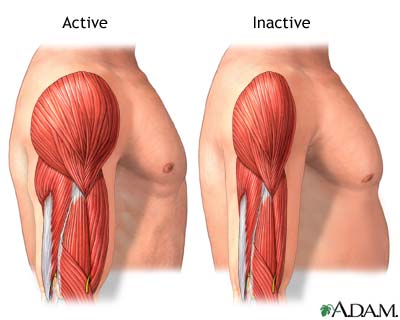
It happens earlier in women than in men, but in both genders muscle starts to wither away if it’s not used.
University of Maryland’s Ben Hurley and Coopers Institute’s Steven Blair point about muscle mass loss and inactivity:
- Muscle atrophy for people with average activity levels starts at age 40 for women and in the late 50s for men
- For every decade after about age 50, you lose some 6 percent of your muscle mass, which comes with a 10 to 15 percent loss of your strength
- Anyone can build muscle back up with strength training exercises. After two months of training, we see a 40 percent increase in strength
- The earlier you start, the better. But even people over 100 years old can partially reverse some of the loss that occurs with aging
- The trick is to not just use the muscle, but to overload it. You have to make it work harder than it’s accustomed to
- If you overload it in a gradual, progressive way, you can make the muscles bigger and stronger by making each muscle fiber thicker
Posted in The cost of inactivity | No Comments »
December 16th, 2007 Milan
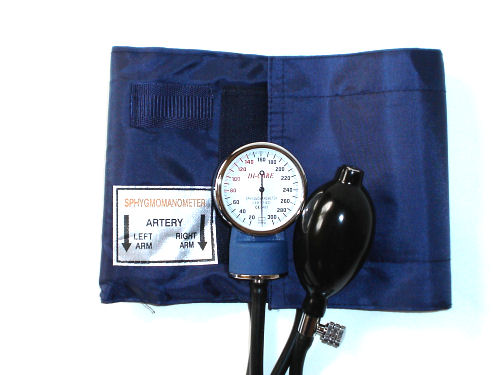
High blood pressure comes with a warning. It’s called pre-hypertension, and it’s easy to detect. All it takes is blood pressure cuff like the one at your local drug store, or your doctor’s office. You can even buy one to use at home.
If your pressure reading has a top number that’s between 120-139, or bottom number that’s between 80-89, you’ve got pre-hypertension.
If your top number is between 140-159, or your bottom number is between 90-94, you’ve got mild hypertension.
If you reach or exceed 160 top, or 95 bottom, it’s considered high blood pressure.
Reduce your risk. If you test your blood pressure and it’s on the high side, what can you do?
- Exercise. Just 30 minutes of vigorous walking on most days should do the trick. But, please do more, add weight-resistance training at least two nonconsecutive days a week, hike, play games, swim, bike. Exercise also helps ease stress, which can also make blood pressure go up.
- Eat better. The foods you choose can make a big difference in your blood pressure. Eliminate fat and salt. Eat more fruits, vegetables, low fat dairy foods, lean chicken meat and fish
- Loose weight. When it comes to weight loss, every little bit counts. For every two pounds you loose, your pressure will come down a point or so. Five or ten pounds can make the difference between pre-hypertension and normal blood pressure
- Stop smoking. Smoking is horrible for blood pressure. It makes the walls of your blood vessels stiff, which drives up your numbers
Posted in Active lifestyle | No Comments »
December 14th, 2007 Milan
Fitness walking, which basically means walking regularly, is an excellent fitness routine.
Here are some tips for walkers:
- Keep your shoulders down and your back straight
- Bend both elbows to 90-degree angles
- Pump your arms front to back as you walk. (This may sound obvious, but some people try to keep their arms still while they walk)
- Keep your stride at a natural length
- Point your toes straight ahead
Posted in Fitness Walking | No Comments »
December 12th, 2007 Milan
If you are just starting to exercise, try walking first to ease into a routine. If you are overweight, or haven’t exercised for awhile, walking is an easy, small impact way to get fit.
Running or walking a mile burns about 100 calories.

Walking very slowly won’t make you super fit, but it’s a great way to condition yourself to separate the time and mental space for exercise, and to prepare your body for running, if that’s what you want to do. Here is the simple plan from walking to running:
- Start slowly, for the first week, start off by walking every other day for 15 minutes
- Second week - add little speed to your walk
- Third week - walk every other day for 20 minutes, ad more speed
- Fourth and fifth week - try walking every day, and try walking for 20 then 30 minutes at a time
- Sixth week - try to run for a 1 minute after each five minutes of walking for total of 30 minutes - every day
- Seventh week -walk 5 minutes - run 5 minutes for total of 30 minutes every second day; only walk for 30 minutes the rest of the days; have a 1 day off if you wish
- Eight week - walk 10 minutes, run 10 minutes for total of 20 minutes every second day; only walk for 30 minutes the rest of the days; have 1 day off if you wish
- Ninth week - walk 15 minutes, run 15 minutes for total of 30 minutes every second day; only walk for 30 minutes the rest of the days; have 1 day off if you wish
- Tenth week - start running 20 - 30 minutes at a time every second day; only walk for 30 minutes the rest of the days; have a 1 day off
Posted in Fitness Walking | No Comments »
December 10th, 2007 Milan
No! Women I train gain about 9 percent of muscle mass, enough to make an enormous difference in their strength. But they loose a corresponding amount of fat - and since muscle is denser than fat, they become trimmer. They don’t complain about looking unfeminine. On the contrary, they are delighted with their slimmer figures.
Women bodybuilders go to great lengths to produce those bulky muscles. They use extremely heavy weights, have lengthy intense workouts, and often take steroids and follow rigorous diets.
Posted in Weight training | No Comments »
December 7th, 2007 Milan
Beside building muscles and increasing strength, strength training has more benefits:
- Halts bone loss - and restores bone
Each year after menopause, a woman typically loses 1 percent of her bone mass - even more during the first five post menopausal years. Over time, she may develop osteoporosis, a condition in which bones become so porous they easily break. Strength training significantly enhances the bone density.
Our ability to stay in balance declines with passing years. Those who regularly weight train perform significantly better at balancing tests than sedentary people and those active but without regular strength training.
- Helps prevent bone fractures from osteoporosis
The improvements in strength , bone density , and balance have special significance for women because they dramatically reduce the risk of fractures from osteoporosis.
The stronger you are, the easier is to move.
People who weight train gain muscle mass and in the same time while loosing body fat they loose also inches.
Gaining muscle not only promotes aerobic activity, which burns calories, but also boosts metabolism. That’s because muscle is active tissue and consumes calories; stored fat, on the other hand, is inert and uses very little energy.
When strength training exercises are performed with maximum range of motion, they improve flexibility of the muscles.
Strength training makes you feel great. It gives you a positive feeling about anything you want to do.
Posted in Weight training | No Comments »