Teaching you how to achieve superior health, leanness and performance.
March 25th, 2008 Milan
When you start with exercise program and you resistance train, gaining weight is possible, you gain muscle and muscle weighs more than fat.
For beginners, you will notice some weight gain at the beginning of a work out cycle because of the dramatic increase of lean muscle mass, but these will later decrease as your body settles into it’s new frame and you stay active and follow your exercise program.
The important thing is the improvement of your body composition and health.
For example, when I stop working out, I will lose about 10 pounds in a month not doing anything. But I will lose muscle mass, which is not good. I will probably gain that weight back if I don’t exercise for a long period of time, but it will be fat.
The point is, you want to gain healthy muscle mass, which makes your body a very efficient calorie burning machine. And when you gain that active muscle mass weight in the beginning of your workout cycle, that will increase your metabolism and those muscle engines will burn that fat your body stores.
How far you can go with this is up to you. Combination of both consistent and intensive – resistance training and cardiovascular exercise and proper nutrition will dramatically increase your body’s potential to burn the energy that is being stored.
Read also: Why fad diets don’t work
Posted in Weight loss | No Comments »
March 23rd, 2008 Milan
People are usually looking to achieve fat reduction, not a muscle reduction.
You could be 120 pounds and look completely out of shape while someone who is 150 pounds and has significantly lower body fat will have a much leaner physique and a healthier body composition.
Optimal combination of three key factors each dependent on the other to lose fat and gain lean muscle mass will contribute to your search for perfect body:
1. Nutrition – regulate the energy that goes to your body
2. Cardiovascular Exercise - increase the amount of energy burned
3. Resistance Training - build active muscle mass and develop muscular endurance
Imagine you are on a healthy balanced diet of wholesome foods and the energy you consume is 2000 calories a day. Since you do not exercise, I will assume that your body’s metabolic rate , the rate at which your body expends the energy at rest or sleep, is 1500 calories. That means that you accumulate 500 calories every day minus your daily activity.
Now, let’s add the resistance training. When you build some muscle mass, it will increase your body’s potential energy use to, let say 1700 calories (1 pound of muscle needs about 50 calories/day just to maintain it) + you burn another 200 calories while you work out. Already you decreased the energy you accumulate from 500 calories per day to 100 calories.
Finally, lets add the cardiovascular exercise assuming an expenditure of 300 calories on treadmill or any other cardio exercise. You are now loosing 200 calories every day.
Posted in Weight loss | No Comments »
March 20th, 2008 Milan
There is very little people who hasn’t tried losing weight fast, too fast through fad diets, fasting, overly restricting their caloric intake, and other such attempts at starving themselves into thinness.
There are two main problems with these approaches to losing weight.
First, they seriously jeopardize our health.
Second, such dieting are fundamentally counterproductive.
Ultimately, they don’t work:
- we loose fat, yes, but also a large measure of muscle
- we unintentionally lower our metabolism
- we set the stage for gaining fat increasingly faster in the future when we come off the diet, and thereby get caught up in perpetual dieting
- we receive inadequate nutrients in imbalanced combination
- we drain the entire body from energy
Fasting and very low calorie diets (diets below 500 calories) cause a loss of nitrogen and potassium in the body, a loss which is believed to trigger a mechanism in the body that causes us to hold on to our fat stores and to turn to muscle protein for energy instead.
Don’t use fad diets to loose weight!
No system on severe food deprivation is wise way to loose weight. Even on the total fast, because you’re loosing muscle and altering your metabolism, you’ll actually be loosing less weight in the end than if you ate 100o – 1500 calories of protein and good quality carbohydrate rich foods every day combined with exercise.
For example, weight lost on high fat, high protein diets like Atkins Diet is primarily water loss, and even that water is lost largely during the first few weeks. This weight is quickly gained back.
Posted in Nutrition | No Comments »
March 15th, 2008 Milan
Abdominals are the focal point of a well-developed physique. A lean, muscular waistline is indicative of the active lifestyle.
Here are the main keys to exceptional abdominal development:
- Keep repetitions between 10 and 30
- Eliminate exercises that tend to emphasize the development of the hip flexors
- Work out from large to small (lower abdomen, than right, left outer abdomen and than upper abdomen)
- Maintain constant tension on the muscles
- Emphasize quality of movement not quantity of movement
- Attack the abdominals from variety of angles using a variety of movements
- Train your abdominals 3 to 4 times a week
- Reduce caloric intake and increase energy expenditure to reduce body fat levels.
Other important facts about abdominal muscles:
Abdominal exercises do not “spot reduce” fat from the waist.
By eating wisely and exercising properly, it is possible to increase your lean muscle mass while decreasing your body fat %.
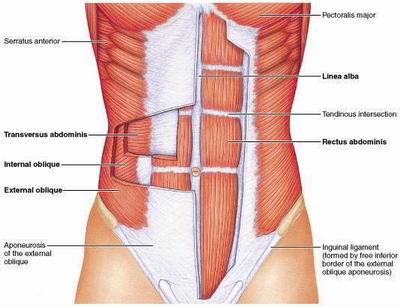
The abdomen is comprised of four muscles:

The abdominals can be divided into four major chambers:
The rectus abdominis is the largest of the muscle groups that comprise the abdomen, so train the rectus abdomens first, more specifically, the lower chamber of the rectus abdominis.
As you train these lower chamber, both side chambers and the upper chamber are also receiving some work.
If you were to train the upper chamber first, your lower abdomen would not become completely exhausted because the smaller upper chamber would fatigue before the larger chamber.
You should train your abdominals:
- lower chamber first
- the right/left outer chambers second
- upper chamber third
Naturally, the upper chamber won’t require much extra work because these chamber receives a great deal of work during the other abdominal movements.
Posted in Exercise planing | No Comments »
March 12th, 2008 Milan
There are many ways to define physical fitness.
I like this one the best:
Optimum physical fitness is the condition resulting from lifestyle, that leads to the development of an optimal level of cardiovascular endurance, muscular strength, muscular endurance and flexibility, as well as the achievement and maintenance of ideal body weight.
Cardiovascular endurance,
also referred to as aerobic fitness, describes the ability of the cardiovascular/cardiopulmonary system (heart, lungs, blood vessels) to deliver an adequate supply of oxygen to exercising muscles.
Muscular strength,
is the maximum amount of force a muscle or muscle group can develop during a single contraction.
Muscle endurance,
is the number of repeated contractions a muscle or muscle group can perform against resistance without fatiguing, or the length of time a contraction can be held without fatigue.
Flexibility,
describes the length of movement which can be accomplished at a joint, such as shoulder, knee, usually referred to as the “range of motion of a joint.”
Ideal body weight,
represents an ideal body composition:
- Body fat
- Lean body mass – represents all the body’s weight, excluding fat – muscles, bones, organs, and nervous tissue.
It is possible to measure one’s level of fitness in each of the areas of optimum fitness using a variety of fitness tests.
You can probably already tell, considering your lifestyle and nutrition if you are in optimal fitness.
Posted in Health and fitness | No Comments »
March 10th, 2008 Milan
It depends on your level of fitness and how many exercises and sets you are going to perform.
For all body weight training per session: 50 – 60 minutes is a right time.
Don’t forget, that you have to:
- Warm up for at least 7 min before workout
- Stretch for 5 min after warm up
- Cool down for at least 2 minutes at the end of the workout
If you are pressed for time, you can do a primary weight training session at the gym, and finish at home (push ups, abdominal exercises).
The key is to perform quality session and to perform the exercises with serious effort.
Posted in Exercise planing | No Comments »
March 8th, 2008 Milan
2 to 4 days of rest, depending on the intensity of the workout is the right time for recovery, writes Ben and Joe Weider in their book The Edge – The Weider Guide to Ultimate Strength, Speed and Stamina:
The exact time it takes your muscles to fully recover from a weight training session will depend on your genetics, sex, age, and level of fitness. In general men recover more quickly than women, and young people recover more quickly than people 35 an over.
You usually need 3 to 4 days for muscle group to recover after high intensity weight training, and 2 to 3 days to recover after moderate and light weight training sessions.
I think, that 4 days is too long of a recovery time for exercised muscle group even if it’s worked out very intensively.
There should be at least 1 day, but not more than 3 days between workouts that stress the same muscle group or groups.
Examples of scheduled weight training sessions:
All body weight training per session # 1: Mondays and Thursdays
All body weight training per session # 2:
Tuesdays – high intensity
Thursday – low intensity
Sunday – high intensity
Split routine:
Monday – upper body
Tuesday – lower body
Thursday – upper body
Friday – lower body
Posted in Exercise planing | 1 Comment »